

Choosing a major is one of the first adult decisions that the students are asked to make. However, the majority of students are supposed to make a decision without having a glimpse of what that career will be like in practice.
The pressure is also rampant and more so between Grades 10–12. Parents are concerned with the consequences. Students are afraid of making a wrong decision. The issue of employability becomes one that is always present. The central theme of this is that most students find themselves in this trap of choosing what is safe, popular or familiar as opposed to what is actually the correct choice.
This is not the time to be threatened but to take advantage of the moment. The researched students will develop a sense of clarity, confidence, and direction, which are the most important attributes in the college applications process at universities.
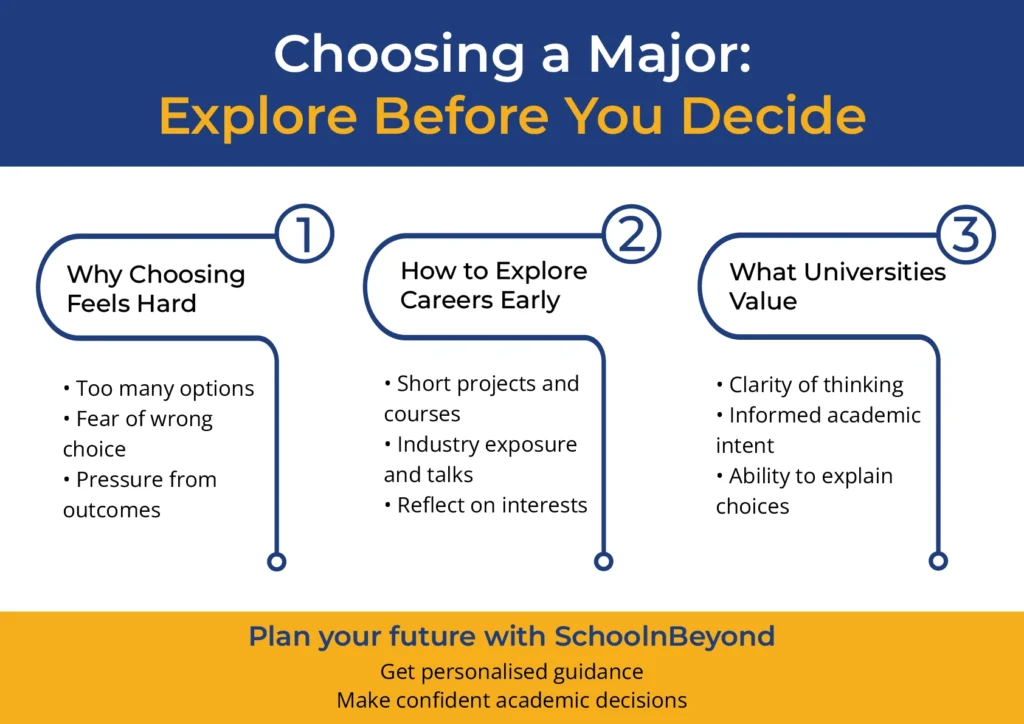
Why is Major Selection so Intimidating Nowadays?
The selection of majors used to be a simple choice of a very familiar list a few decades ago. The academic environment nowadays is much more expansive. The speed of changing industries, interdisciplinary courses and worldwide career options has proliferated options greatly.
By 2025, the US, UK and Singapore universities started to note that an increasing number of students are changing their major in the first year, not because they cannot, but because they have not been exposed to it.
There is no expectancy of lifetime certainty in universities. They anticipate informed decision making. The purpose can be seen when students get to know about careers prior to committing themselves to academics.
The Reasons Barriers to Majors Are Not Job Titles, but Academic Pathways.
A major does not mean employment – it provides a platform.
For example:
- The student who wants to explore psychology can do research, policy, user experience, education, or healthcare.
- A student with an engineering orientation can find interests in design, sustainability or management.
Students who appreciate this flexibility are appreciated by admissions committees. Discovering the relationship between majors and various career outcomes minimizes the chances of doing the right thing in the wrong way.
This is the point where college counseling and study abroad counseling can assist the student in linking the academic decision-making to the possibilities in the real world instead of stereotypes.
What can students learn about careers they can pursue before deciding a major?
Expensive internships and formal placements are not needed during career exploration. Experiences of low pressure, exploratory are usually more productive.
Students are stimulated to investigate by:
- Professional informational interview
- Online classes were in tandem with potential majors
- Job shadowing or virtual job shadowing
- Short term exploratory or research projects
- Case study and analysis of real world problems
Such experiences assist the students to respond to critical questions:
- What excites me?
- What drains me?
- What are my natural areas of strength?
Such clearness reinforces essays and stories quite frequently with the help of college application services.
What Does Academic Exploration Build Applications?
Universities are starting to prefer applicants who have an articulate reason as to why they selected a specific major.
Students who pursue careers at an early age relate academics to the real world. This reinforces essays, interviews and recommendations—particularly when students write reflective application essay themes rather than speculative ones.
Admissions officers do not strive to achieve certainty. They appreciate integrity, logic and self-understanding.

What is the Benefit of Interdisciplinary Exploration in the Decision-Making?
A lot of students are confused about various interests. Rather than making one rush to make a judgment, interdisciplinary exploration can provide sanity.
Examples include:
- A business and technology student who is studying product management
- A learner attracted to social contribution and biology with the focus on the population health
These cross-roads tend to open up educational directions students had not originally thought about.
Mentoring of individual application assists students to realize the trends in their interests and make sense of confusion through exploration.
What Relationship Does Career Exploration Have with Scholarships?
Clarity in career is important in achieving success in scholarship. In most global scholarship programs, emphasis is placed on purpose, direction and alignment between academics and long term goals among students.
Whether on their applications of scholarship, students who are able to narrate their career exploration prior to deciding on a major usually portray anchored, genuine scholarship applications.
This is the point where personal scholarship counseling comes in to enable students to sound natural, not practiced or monotonous.
Reasons why Students should not rush with major decisions.
Among the most harmful wrong assumptions is the rivalry of the notion that all of it must be resolved by Grade 11. Universities know that the interests change.
However, it is the process that counts more:
- Exploration
- Reflection
- Informed reasoning
When students are able to show this process they are seen as well prepared compared to those who make early and uninformed decisions.
Individual college application counseling helps to develop the belief that uncertainty is not a sign of weakness but a sign of development.
What Are the Benefits of Supporting Career Exploration by the Structure?
Academic and career exploration is balanced with the long-term strategy. Effective instructions assist students to:
- Identify genuine interests
- Learn the academic routes in the world
- Relate majors to career outcomes
- Develop applications rationally
This makes sure that students do not just choose a major without knowing the reason why that major suits them.
Summary: Discovery: The Key to Making Better Decisions.
No major prediction can be idealistic when selecting an important major. It is all about informed decision-making and the basis of it is curiosity, exploration, and reflection.
Students that investigate careers prior to choosing a program are highly motivated, goal-oriented and confident when they come into the university and this reflection is evident in applications, interviews, and opportunities to come.
Get a bit of one-on-one counsel, or follow SchoolnBeyond on Instagram, LinkedIn, and Facebook to get some ideas of global education and admission strategy.