
The question that is being posed to parents and students each summer is the same one: Which summer programs do assist in college admissions, and which ones only look great on Instagram?
This question is more relevant than ever in 2026. Universities have started competing post-COVID; test-optional policies and holistic review have altered the ways students are evaluated. Admissions teams at the top 20 global universities are no longer impressed by participation alone. They seek purpose, richness, and outcomes.
The existence of a summer program does not make it worthwhile. It is valuable because of what is done with it by the student. This guide breaks down how to choose summer programs that genuinely strengthen your college applications process, especially for students applying globally.
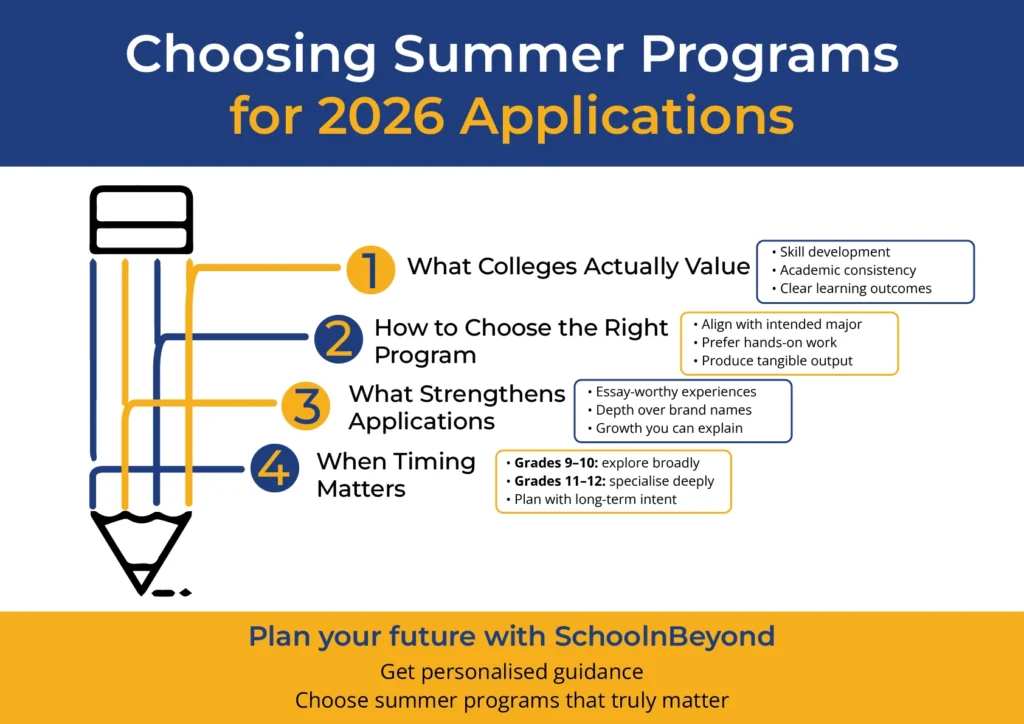
What Does the University Really Want in Summer Programs?
In spite of the facts, universities are not ranking summer programs by brand name.
Colleges are more concerned about the following in the 2025–26 admission cycles:
- Skill development
- Intellectual curiosity
- Academic interest consistency
- Reflections and learning outcomes
A lesser-known program aligned with a student’s goals often carries more weight than a popular one chosen without purpose.
Summer programs are evaluated in context – as part of the overall student profile, not as a standalone trophy.
Is the Program Incorporated in the Academic Direction of the Student?
Alignment is the first and most significant filter.
A strong summer program must connect logically to:
- Intended major
- Academic interests
- Long-term goals

For example:
- A student interested in economics may benefit from data analysis, policy research, or entrepreneurship programs.
- A STEM-oriented student may explore enterprise-based or problem-solving programs.
- A humanities-focused student may gain more from writing, debate, or social research projects.
Programs chosen without alignment often weaken applications. This is where personal college admissions guidance becomes critical.
Is It an Active or a Passive Program?
Passive experiences are increasingly viewed skeptically by admissions officers.
Programs that strengthen applications tend to include:
- Hands-on projects
- Problem-solving, investigation, or design
- Presentations, reports, or portfolios
Lecture- or attendance-based programs add limited value unless paired with independent output.
When students work with college application help, one guiding question becomes essential:
What will I actually come out with at the end of this program?
Will the Experience Support Essays and Applications?
One of the clearest signs of a strong summer program is whether it can meaningfully support common application essay topics later.
Strong summer experiences provide:
- Moments of challenge
- New perspectives
- Growth or decision-making stories
If a student cannot clearly articulate what they learned or how they changed, the program – however prestigious – will not meaningfully strengthen their application.
Is the Program Appropriate for the Student’s Grade Level?
Timing matters.
Grades 9–10 students benefit more from:
- Exploration-based programs
- Skill-building experiences
- Broad exposure
Grades 11–12 students should focus on:
- Depth and specialization
- Research or advanced projects
- Major-affirming experiences
This progression is especially important within one-on-one college counseling, where summer planning aligns with long-term strategy.
Are Paid Programs Automatically Better?
No—and this is critical for parents to understand. Many expensive programs lack personalization, while lower-cost or free programs can be far more effective if used well.
With access and equity playing a larger role in 2026, admissions teams care about how students use opportunities – not how much those opportunities cost.
What matters is initiative, effort, and reflection.
Do Summer Programs Support Scholarships?
Yes – when chosen strategically.
Many international scholarship programs value leadership, academic initiative, and sustained subject engagement. Well-documented summer experiences can significantly strengthen scholarship profiles.
For families seeking scholarship guidance for Indian students, early summer planning can meaningfully improve outcomes.
How Should Summer Programs Be Presented in Applications?
Summer experiences should never be listed vaguely.
Strong applications clearly explain:
- What the student did
- What they learned
- Why it mattered in their academic journey
This clarity is essential when understanding how to submit college applications effectively.
Students supported by one-on-one college application counseling consistently present summer programs with greater impact by focusing on outcomes – not descriptions.
Why Personalized Planning Matters Most
One of the biggest mistakes families make is selecting summer programs in isolation.
Summer planning is most effective when aligned with:
- Academics
- Research interests
- Extracurricular depth
- Scholarship goals
This integrated approach is especially powerful within study abroad counseling and one-on-one study abroad counseling frameworks.
Recap: The Right Summer Program Cuts Through the Clutter
The best summer programs do not try to make students stand out loudly.
They help students become clear.
Admissions officers remember clarity in a competitive 2026 admissions environment.
The right summer program does not add noise.
It adds direction.