

In the quest to join the best universities in the foreign countries, there is one question that determines how all students will be competing: Which school curriculum will provide me with the best edge?
By 2025, universities all over the world will not be judging grades anymore but they will be judging academic rigor, critical thinking, and international readiness. Your selection of course can have a direct impact on your admissions chances, scholarship and even your university life.
This paper deconstructs the comparisons between AP, IB, A-Levels, and CBSE, what universities around the world actually care about, and what to do to choose the right path to your aspirations.
The Understanding of Global Curriculums
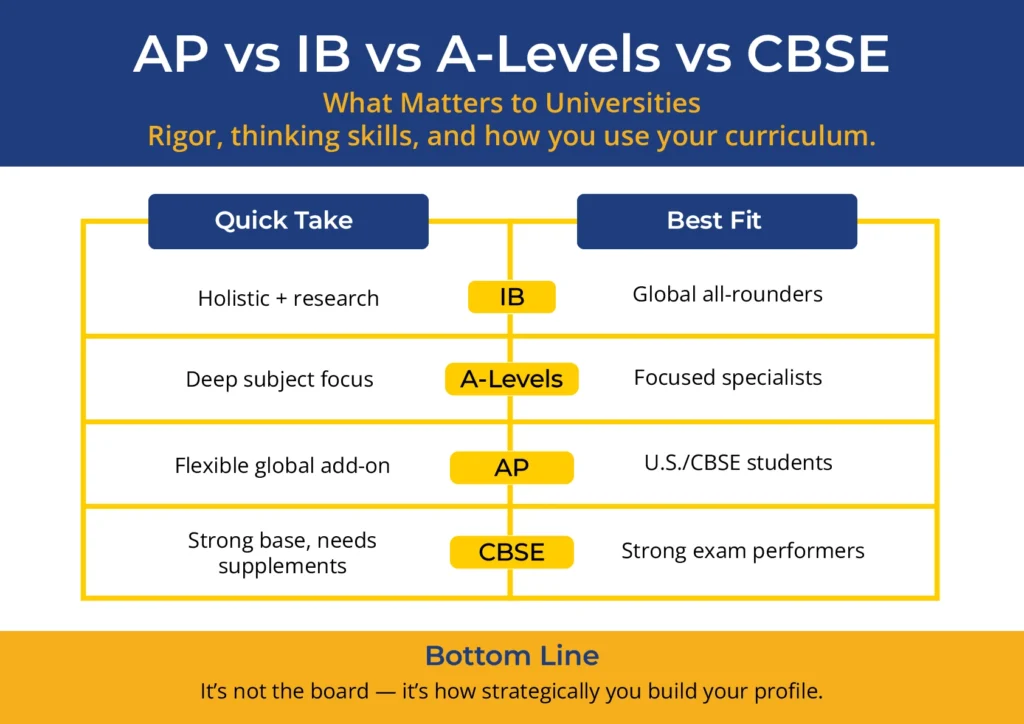
Each curriculum possesses a philosophy — and the knowledge of these can assist you to fit in the global university expectations.
AP (Advanced Placement): AP development began in the USA and is a subject-specific course students can take in addition to their normal schooling at the college level. It suits people pursuing the aim of specializing early or enhancing university applications in the U.S.
IB (International Baccalaureate): IB is also holistic in nature which focuses on critical thinking, research, and community service. The top 20 global universities have made it one of their most valued programs in making balanced globally aware students.
The A-Levels: A-Levels enjoy popularity in the UK, Singapore and some of the Middle East regions, and are concerned with academic rigor. Students are usually given 3–4 subjects and they study them in detail in two years.
CBSE (Central Board of Secondary Education): CBSE offers a good background in knowledge and uniformity in instruction, which is common in India as well as in the UAE. It is known worldwide, but to get admitted internationally students usually need to add AP tests, or extra-curricular richness.
One-on-one college counseling at SchoolnBeyond assists students to review every curriculum based on their chosen destination: the U.S., U.K., Canada, Europe, or Asia as a way to ensure that their academic options reflect their long-term objectives.
The Rationale of Curriculum Choice
The curriculum influences the interpretation of your academic strength in the universities. Although grades are important in all locations, the admissions officers tend to rank them based on curriculum rigor.
This is the importance of this decision:
Sets the Academic Tone
Every curriculum is indicative of the level of exploration. Specialization A-Levels are a balance; IB demonstrates being college-ready; A-Levels demonstrate discipline and conceptual strength; CBSE assures.
Affects Readiness to University
A difficult schedule will get you ready for the level and the requirements of college. The transition of students with IB or A-Levels is also facilitated by theoretical coursework.
Impacts on Scholarship Opportunities
Rigorous systems enjoy a competitive advantage in the international scholarship programs. IB Diploma or a mix of both CBSE and AP is likely to receive a higher rating in terms of scholarship guidance for Indian students.
Affects Your Application Strategy
Curriculum defines the way you rank your academics in the college applications process. Indicatively, AP and IB provide course work to reinforce essay discussions whereas the CBSE students might be more dependent on projects, Olympiads and individual performances.
Shapes Global Recognition
There is different familiarity of universities in the various regions. A-Levels are popular in the U.K. and Singapore, and IB is widely acknowledged in all other countries of the world, AP is the emperor in American soil.
Comparison of AP, IB, A-Levels and CBSE
Now, we are going to compare how each curriculum is different in the admissions value:
1) Academic Rigor
- IB: Deep data of academic comprehension and research (Extended Essay) and Theory of Knowledge.
- A-Levels: Intense specialization — suits best students with established academic interests.
- AP: Without strict intensity; the learners have the freedom to choose the topics to improve their applications.
- CBSE: More conceptually, but less research based, structured.
2) Skill Development
- IB: Accomplishes leadership, writing, and critical-thinking with the help of experience.
- A-Levels: Teamwork; focused on independent study and analytical writing.
- AP: Concentration, self motive and time management.
- CBSE: Approves a powerful theoretical and exam-based knowledge.
3) Global Acceptance
- IB: Adopted by 5,000 universities in the world.
- A-Levels: Very well regarded in the U.K. as well as in Europe and the Commonwealth countries.
- AP: Accepted in the most prestigious universities in the United States, Canada and to a growing extent in Asia.
- CBSE: It is known worldwide but standardized tests such as SAT or AP are mostly demanded by universities to make comparisons.
4) Best For
- IB: Moderate students who like to conduct research and be globalized.
- A-Levels: Students that aspire to subject-specific excellence.
- AP: Students seeking the option of individualizing the academic profile.
- CBSE: Students with strong national board performance.
Constructing a Global Admissions Profile
There is no best curriculum, but there is always a way to use it and make your story. Colleges seek initiative, stability and richness in your select system.
This is how to build up your profile regardless of which curriculum you are pursuing:
- Display Challenge, Focus: Show Subject Depth Coursework by taking advanced or optional modules.
- Complete Research or Projects — An independent study or a portfolio or science fair is credible.
- Connect Academics to Extra-Curriculars: Connect classroom instructions with club forms and activities, competition and community services.
- Request Hearty Recommendations: Teachers who are well informed on global admissions will be able to put your performance in perspective.
- Professional personal college admissions guidance — Experts in college advising may assist in strategizing your curriculum in essays and interviews.
SchoolnBeyond now hosts mentors that attend to learners with CBSE, IB, A-Level and AP qualifications in order to create a balanced portfolio by providing one-to-one application advice and study abroad guidance.
Global Admissions Trends in 2025
Based on QS and UCAS 2025 perceptions:
- There is an increase in the application of IB to the best universities by 18 percent since 2022.
- The numbers of students taking AP exams outside the U.S. have increased by 24%, particularly in India and Singapore.
- The A-Level students have the highest direct acceptance rates in the U.K.
- Indian CBSE students are also taking up more and more AP subjects in order to enhance global comparability.
These tendencies confirm a single fact — universities appreciate flexibility and provocation. Both of them should be emphasised in your curriculum.
Making the Right Choice
IB/AP/A-Leves/CBSE options must be settled on, based on your career choice, choice of location of study and your learning style.
- Planning to study in the U.S.? Choose AP or IB.
- Striking at U.K. or Singapore? A-Levels provide ministerial bias.
- Between Indian training and international recognition? AP +CBSE is a good combination.
And however you choose to study, global higher education prioritizes inquisitiveness, uniformity and genuine interaction, which can be evident whichever course you are taking provided that you put it forward in an intelligent manner.
Conclusion
It is your curriculum which lays the groundwork but it is your hard work which determines the result. No matter which system you study under, be it CBSE, IB, A-Levels, or AP, universities are interested in how best you have utilized it as opposed to what board it was.
SchoolnBeyond, based in India, the UAE, Singapore and Qatar, offers one-on-one college counseling and study abroad guidance to students in order to match their academic courses with international demands.
SchoolnBeyond is a flat rate study abroad advisory and global admission consulting firm. Keep up with us on Instagram, LinkedIn, and Facebook to get timely updates, study abroad, and admissions trends all over the world.